
AirPlay / Google Cast / DLNA-UPnP
Casting vs screen mirroring on iPhone
Understand the difference between casting personal photos or videos and continuously mirroring an iPhone screen to a TV.
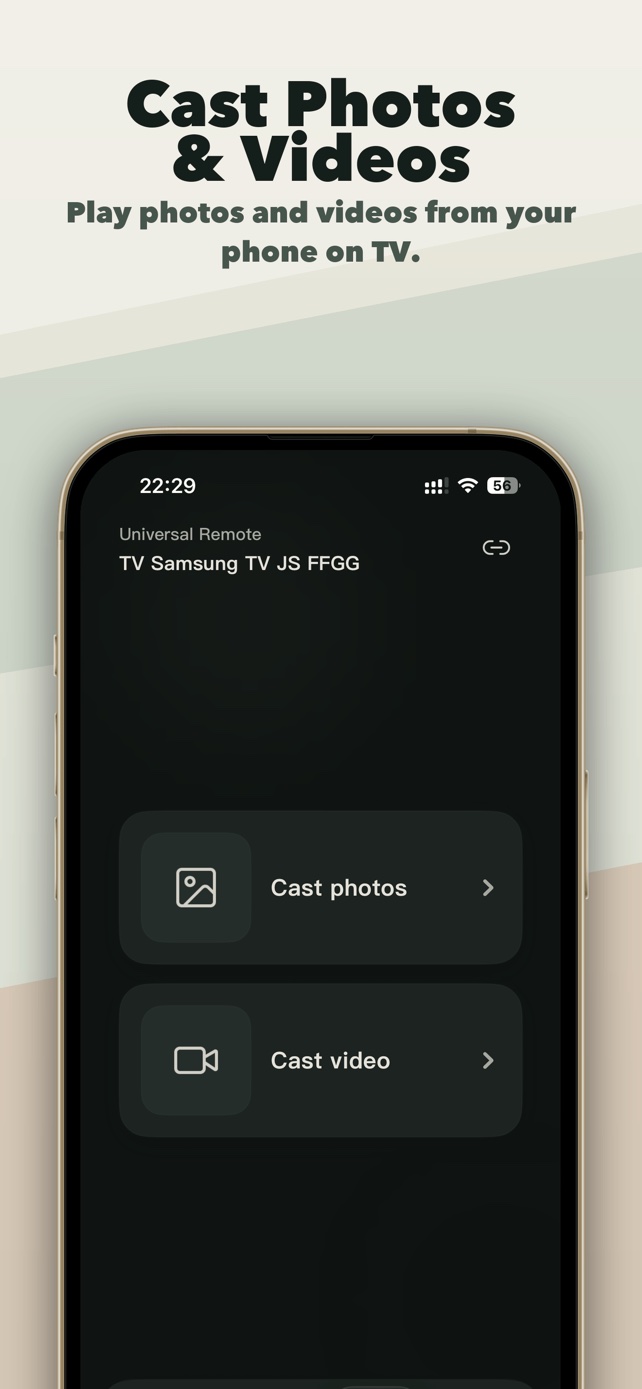
For compatible models using AirPlay / Google Cast / DLNA-UPnP, keep the iPhone and TV on the same trusted home network. Choose the receiver and send a compatible personal photo or video. A cast session controls that media item; it is not continuous iPhone screen mirroring. No all-model promise. Confirm the TV operating system and the manual for the exact model.
Applicable scope
Compatible models using AirPlay / Google Cast / DLNA-UPnP that expose a supported local-control service. Available features vary by model and software version.
Brands and product families
Verification record
- Connection scope
- AirPlay / Google Cast / DLNA-UPnP
- Released app version
- This guide is checked against TVRemoteX 2.2.0 on the App Store.
- Relevant references
- 4 linked manufacturer, platform or developer reference(s)
- Exact-model boundary
- No all-model promise. Confirm the TV operating system and the manual for the exact model.
- Page reviewed
Support still depends on the television model, operating system, firmware, region, network and power state.
How TVRemoteX verifies this guide →Connection steps
Confirm the TV platform first
Open the TV's About, Support or System information screen and note the operating system or model. Multi-platform brands such as Hisense, TCL, Toshiba, Philips, Sony and Xiaomi can use different control routes.
Put both devices on the same local network
Connect the iPhone and TV to the same home router. Do not use guest Wi-Fi, a VPN that captures local traffic, or router client isolation while pairing.
Allow iPhone Local Network access
When iOS asks, choose Allow. If it was denied, open Settings > Privacy & Security > Local Network > TVRemoteX, enable TVRemoteX, return to the app and scan again.
Keep the TV awake, then select it in TVRemoteX
Leave the TV on its Home screen, open TVRemoteX, start discovery and choose the matching device name. Do not approve a request you did not initiate.
Pairing behavior
Choose the receiver and send a compatible personal photo or video. A cast session controls that media item; it is not continuous iPhone screen mirroring.
Verify control before relying on advanced features
Test Home, Back and one volume command first. Keyboard, app launch, wake and casting are separate capabilities and may not be exposed by the selected route.
Optional technical detailsProtocol names and software-generation differences are kept here for advanced troubleshooting. Most people can follow the connection steps above without using this section.
Differences by model and software
Menu names and feature availability can vary by model, region and software version.
Cast receiver route only; no D-pad remote is claimed.
The TV receives one compatible photo or video and controls that sessionThe brand ships multiple operating systems; choose the platform-specific route.
The TV displays the live iPhone screen through AirPlay-compatible mirroringThe brand ships multiple operating systems; choose the platform-specific route.
Use the service's own AirPlay/Cast button when supportedSymptoms and fixes
| What you see | Likely cause | What to do |
|---|---|---|
| The TV does not appear | Local Network permission, guest Wi-Fi, VPN or client isolation is blocking discovery. | Enable iOS Local Network access, use the same non-guest LAN, pause the VPN and rescan with the TV awake. |
| A photo works but a video does not | The receiver cannot fetch or decode that media format, or protected streaming content blocks redistribution. | Try a common local file on the same LAN. Use the streaming app's own AirPlay/Cast control for protected services. |
| Connected, but buttons do nothing | The TV accepted discovery but blocks third-party control, selected a limited route, or is showing a protected screen. | Check the platform's network-control setting, return to Home and test basic navigation before advanced commands. |
| The brand is found but pairing instructions look wrong | That brand uses another operating system, such as Roku TV, Fire TV, Android/Google TV or VIDAA. | Check About/System information and follow the operating-system guide instead of the logo on the bezel. |
Available features
This summary covers user-visible TVRemoteX compatibility. It is not a promise that every model, firmware, region or power state exposes every command.
Manufacturer help
- 01
- 02
- 03
- 04